Qwen3.8-Max Weights Are Public on Hugging Face — But They Won’t Fit a Typical Local PC
Qwen3.8-Max-class weights are now downloadable from Qwen on Hugging Face. Here's how large the A95B checkpoint really is, what the smallest GGUF costs, and why it is far beyond a typical local PC.

The short answer
The checkpoint that sits behind "Qwen3.8-Max" is now downloadable as open weights from the official Qwen organization on Hugging Face: Qwen/Qwen3.8-2.4T-A95B, plus an FP8 variant, with repo timestamps of August 8, 2026 (Hugging Face org listing).
What it is, in verified numbers:
- About 4,556 GiB (~4.4 TiB) at BF16. The repo’s own
model.safetensors.index.jsonreports a total weight size of 4,892,365,451,008 bytes, which matches the summed file listing (213 shards). - A text-only MoE that cannot run without thinking mode. The vendor card states multimodal inputs are not supported and thinking cannot be disabled — unlike the hosted Qwen3.8-Max service, which adds vision input, non-thinking support, 1M default context, and built-in tools (vendor model card).
- The smallest published GGUF variant still means a several-hundred-GB download. This is Unsloth’s community mirror of the checkpoint: its released GGUF folders span roughly 12 TB (all variants combined), and the smallest, UD-IQ1_M, is about 564 GB across 13 shards on Hugging Face (derived from the repo’s file listing).
The practical answer for a typical local PC: no. The sizes above sit far beyond even the largest mainstream workstations, and the checkpoint’s license is custom “other” rather than Apache-2.0 (the open-weights 27B in this generation is separate). The model Qwen 3.8 actually hands you for home use is still the Apache-2.0, multimodal 27B — and our existing coverage on quant choice, Ollama settings, vision costs, and a real field report tells you what that one does.
What the official org actually publishes now
The Qwen organization on Hugging Face listed four new checkpoints during August 5–13, 2026 (repo creation timestamps from the Hugging Face model API):
Qwen/Qwen3.8-27B— Aug 5 (the local-first model our other articles cover)Qwen/Qwen3.8-2.4T-A95B— Aug 8, the Max-class base checkpointQwen/Qwen3.8-2.4T-A95B-FP8— Aug 8Qwen/Qwen3.8-27B-FP8— Aug 13
The A95B checkpoint’s shipped config.json (read directly from the repo) confirms a Mixture-of-Experts text model with 92 layers, hidden size 8,192, and 512 experts activating top-10 per token — consistent with the “A95B” naming. Its architecture fields include hybrid linear-attention markers (mamba_ssm_dtype, linear_conv_kernel_dim), so it is not an ordinary dense attention model.
Licenses differ by size, and this matters:
- Qwen3.8-27B: Apache-2.0, declared in the official model card; the card also marks it an image-text-to-text (multimodal) pipeline.
- Qwen3.8-2.4T-A95B: a custom license — Hugging Face metadata lists
license: otherwith the nameqwen3.8-max. I did not retrieve the full license text, so if you are embedding this checkpoint commercially, read that document before doing anything with it.
The size math: why a typical local PC cannot run it
For the weight file on disk, the vendor’s own index metadata leaves no ambiguity. Qwen/Qwen3.8-2.4T-A95B/model.safetensors.index.json reports:
- Total weight size: 4,892,365,451,008 bytes ≈ 4,556 GiB (≈4.4 TiB), spread over 213 safetensors shards (metadata value from the repo itself — vendor self-report).
That is just the weights at BF16, before any KV cache, activations, or framework overhead are added — so a full-precision run implies roughly five terabytes of system-memory-class capacity. [inference: combining the verified total_size with standard inference memory layout] No consumer machine comes anywhere close to that range by an order of magnitude.
The lower-precision route is published too, but it only moves the needle by a factor of two:
Qwen/Qwen3.8-2.4T-A95B-FP8exists in the same org (same August 8 timestamp). FP8 halves the weight byte count relative to BF16 [inference from precision arithmetic], which still puts the download and working set in the multi-terabyte band — beyond any single workstation’s RAM without server-class memory. I did not retrieve its index metadata, so treat that figure as estimate.
The community-published GGUF route (Unsloth’s mirror of this checkpoint) is the furthest anyone has pushed it — and look where the smallest tier lands:
- All released quant variants in
unsloth/Qwen3.8-2.4T-A95B-GGUFtotal ≈12 TiB across 314 large files (Hugging Face file listing, derived). - The lowest tier, UD-IQ1_M (~1-bit class), is a 13-shard set at about 564 GB in total across that folder on Hugging Face (measured from the repo’s file listing; individual shards are not evenly sized). Several-hundred-GB download, before you would touch KV cache for its hybrid attention layers.
The open checkpoint is not the Max you’ve used in chat apps
If you have chatted with “Qwen3.8-Max” through a Qwen app or API, know that what you downloaded and what you used are different products. The official A95B model card says it plainly (vendor self-report):
“Qwen3.8-Max is the official version based on Qwen3.8-2.4T-A95B with more features, such as vision input & non-thinking support, 1M context length by default, official built-in tools.”
Concretely, for the downloadable checkpoint (all from its official model card):
- Text-only. Multimodal inputs are not supported — unlike the Apache-2.0 27B sibling in this same generation, which ships as an image-text-to-text pipeline.
- Thinking is mandatory. Per that same card, the checkpoint “requires thinking mode for all interactions… and thinking cannot be disabled.” Its example config reads
"enable_thinking": Truewith the comment “should not be turned off,” andpreserve_thinkingis on by default. - Context: 262,144 tokens natively, extensible up to 1,010,000 — versus the hosted Max’s advertising of 1M as a default. How far you can actually stretch that in practice is vendor-documentation territory I did not independently test.
The card points readers to a Qwen Cloud model page (qwencloud.com/models/qwen3.8-max) for the hosted service’s pricing and tooling details; those figures were outside what I retrieved, so nothing here is quoted from them.
What a local user should actually do
If the question you came here with was “can I get Qwen3.8-Max running at home?” — on a typical consumer PC or local-AI workstation, the verified answer is no: even in extreme ~1-bit community GGUF form it is a several-hundred-GB download before you have anywhere to put its KV cache [derived from the sources above]. This article does not cover server-class memory platforms or multi-GPU clusters; whether the checkpoint fits that kind of machine is outside its scope (the official card includes its own vLLM and SGLang usage examples for exactly those readers, read from the repo).
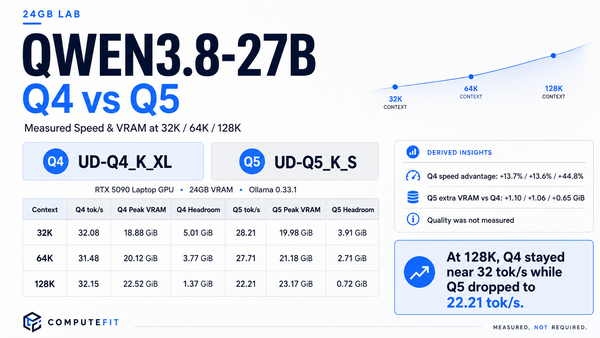
The useful local model of this generation remains Qwen3.8-27B, Apache-2.0, multimodal in its shipped form, and already running on 16–24 GB-class cards at 4-bit. Everything practical about it is covered by the other articles here:
- Should you switch from Qwen3.6 to Qwen3.8 — the upgrade decision, with vendor-published benchmark deltas.
- Which quant file fits your GPU — real Hugging Face sizes for every local-relevant variant.
- What vision input actually costs — per-image token math from the shipped preprocessor config.
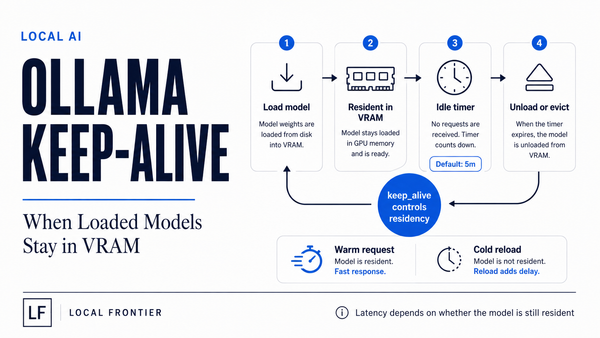
- Ollama defaults and the settings that matter — loaded-context figures, thinking-mode cost, day-one checklist.
Name confusion is worth a final word: in this generation there is no “35B-A3B” Qwen3.8 model. Search results and forum posts sometimes paste that label onto the 2026-April-era Qwen/Qwen3.6-35B-A3B, which does exist in the official org listing (April 15, 2026) but belongs to Qwen 3.6 — a different generation with its own smaller active-parameter profile.
If you later find server-class hardware and are evaluating the A95B checkpoint for real workloads, revisit this space first: its hybrid attention layout means KV-cache behavior in long contexts is likely to behave differently from ordinary dense models of comparable size [inference — not independently verified]. And read that custom license before any commercial use.