Should You Switch to Qwen3.8-27B? An Upgrade Decision Guide for Existing Local LLM Users
A decision guide for people already running a local LLM: what the vendor-published model card says about Qwen3.8-27B versus Qwen3.6-27B, where the reported differences actually matter agentically and multimodally, and how to fit it on your hardware.

Scope note: This article is a decision tool, not a launch coverage piece. Facts in it come from the sources we actually examined for this checkpoint: its Hugging Face model card and config/manifest files, the vendor's serving recipe pages linked there, one third-party quantization doc page (the memory table in §3), plus public aggregator and tracker pages, which inform only the "independent verification is thin" note. Each number below is labeled as vendor-reported or measured-from-metadata accordingly. Nothing was run or benchmarked by us: no checkpoint was pulled or loaded for this article, and there are no "tested" or "we found" claims in it.
1. Verdict first: Switch / Stay table (Qwen3.8-27B vs. what you run today)
Qwen3.6-27B for agent coding
You can host a 4-bit-class build with enough room left over for KV cache and normal runtime overhead.
Text chat, RAG, and short documents
Your current model already handles the workload well and your hardware is close to the model's practical floor.
You need native image or document input
Screenshots, diagrams, photos, and document crops are part of your normal workflow rather than an occasional OCR workaround.
You regularly push past ~100K context
Long-running agent loops and large working histories are common in your sessions.
Your total memory budget is below ~14 GB
RAM + VRAM, or unified memory, is already tight for the model class you are considering.
You mostly use frontier hosted APIs
Your local model is mainly a backup rather than a primary tool for day-to-day work.
Two rules before you act: (a) "newer version exists" is not a reason to migrate — every re-setup has real costs in config churn and lost tuning; (b) if your team's tasks differ from public benchmarks, your A/B against a handful of representative tasks outranks both this article and the vendor's table.
2. What Qwen3.8-27B actually is (confirmed facts)
From the official Hugging Face model card and configuration files:
- Released: the model's repo metadata shows a last-modification timestamp of 2026-08-14T15:00Z. We have not read the vendor's own announcement, so treat "released August 14, 2026" as derived from that metadata rather than press-confirmed.
- License: Apache 2.0 (declared in repo frontmatter).
- Type: dense 27B causal LM with an integrated vision encoder (native VLM — "image-text-to-text" pipeline, no separate text-model/VLM split to choose between).
- Context length: 262,144 tokens natively, and extensible up to ~1M only via RoPE scaling (YaRN) with explicit config changes in the serving framework — vendor docs flag that all currently supported frameworks implement YaRN as "static" scaling, which can impact shorter-text performance. Treat 1M as an advanced setup, not a default capability.
- Architecture note: hybrid layout mixing linear-attention layers (Gated DeltaNet) with standard attention (Gated Attention), 64 layers, trained with multi-token prediction. Why it matters to you: expect per-framework support/config differences rather than drop-in equivalence, and check your serving framework's recipe (below).
- Thinking behavior: thinking mode is on by default; you can disable it per request. 3.8 supports
reasoning_effort(xhigh/medium/low) for reasoning depth, andpreserve_thinking(default on), which carries historical thinking blocks across multi-turn context — designed for agent consistency; official docs give a detailed trade-off discussion for long agentic loops. Whether these two parameters also existed in 3.6 or earlier generations is not something this article verifies here. - Officially supported serving paths: Hugging Face Transformers, vLLM, SGLang, and TokenSpeed — each with an official recipe or cookbook linked from the model card. An Ollama library page exists for
qwen3.8:27b; which quantization that default tag ships is not asserted here because we could not confirm it from a checkable file listing at write time. - Hosted API: a hosted 1M-context version on the vendor's cloud service was announced in the model card but marked "coming soon" at time of writing — do not plan around it as available today.
3. File sizes and memory: no ambiguity between download, weight, and runtime
These are at least two easily-conflated numbers (and a third in the 4-bit row that we simply did not measure); mixing them is how "it fits on my GPU" claims go wrong.
| What | Size | Source & label |
|---|---|---|
| Official weights download from Hugging Face | ~55.6 GB (18 shards, exact total 55,562,855,904 bytes) | Measured on the repo file index; config.json declares text_config.dtype = bfloat16 in its text model block — read directly from Qwen's config file during audit. We did not pull or inspect the weight files tensor by tensor, so per-tensor storage inside the .safetensors files is not claimed here; the ~2-bytes-per-parameter arithmetic on the measured 55,562,855,904-byte download is consistent with a bf16-class checkpoint, and we state that part as arithmetic reasoning only, explicitly separate from the config declaration itself. No FP8 weights are present in this official repo as of our audit; we make no claim about an FP8 version elsewhere. |
| 4-bit GGUF download file | not asserted (exact file size of the published dynamic quants not measured here) | — |
| Runtime total memory needed (RAM + VRAM combined, or unified), per bit level | below | [Third-party tooling vendor's published table] |
Runtime memory table (units are total device memory, i.e., RAM+VRAM or Mac unified — not "free VRAM"; these figures are the third-party tooling vendor's published recommended total-memory budgets per precision class). If your workload runs long contexts, high concurrency, or larger KV-cache footprints than that vendor's published test assumptions cover, you need capacity in addition to those budget numbers — plan above them rather than at them:
| Precision | Total memory requirement |
|---|---|
| 2-bit dynamic | ~11–13 GB |
| 3-bit dynamic | ~13–16 GB |
| 4-bit (practical sweet spot per that vendor) | ~17–19 GB — "works on most devices" like RTX 5080/4090-class or a Mac with 24 GB RAM, per the same table's notes |
| 6-bit | ~24 GB |
| 8-bit | ~31 GB |
| Lossless/full precision | ~56 GB |
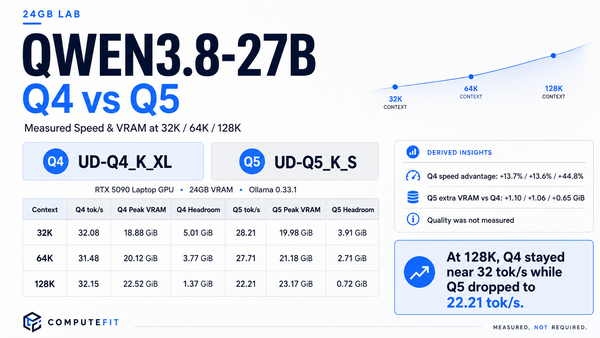
Practical framing for Qwen3.6-27B upgraders: if your current build runs with meaningful KV-cache headroom at a comparable quantization level, the size math roughly carries over (same 27B class); if you are already right at the edge on your current model, assume 3.8's agent-focused usage patterns — long thinking blocks by default, preserved history — will press harder on the same pool than your old workload did.
4. Benchmarks: vendor-reported, plainly labeled
Reading rules before you look at any number below:
- Every figure in this section is self-reported by Qwen on its official model card. We have not reproduced any of them.
- Several benchmarks in the full vendor sheet were built by Qwen itself. In the edited extract below, QwenSWEBench and CoWorkBench are such rows. Qwen3.8-27B posts some of its strongest reported gains over Qwen3.6-27B on these in-house benchmarks, so we flag the included ones separately with †.
- Independent verification as of writing is thin, within the trackers and comparison sites we actually checked: public model trackers list rows for this checkpoint without an independent rank yet; a handful of comparison sites have head-to-head pages generated from published data. Treat that as "exists but not settled," not "confirmed" — and note it covers only what those specific sources contained at write time, not the full extent of independent work elsewhere.
4.1 Qwen3.8-27B vs. Qwen3.6-27B (edited extract of the vendor-published sheet)
The official model-card table has five columns; this one shows only two — Qwen3.8-27B and 3.6-27B, since that is the comparison an upgrader actually makes. Columns for Qwen3.7-Plus and other models are omitted from this extract (the full sheet remains in the model card), along with a few vision rows not central to a text-first read.
| Benchmark (type) | Qwen3.8-27B | Qwen3.6-27B |
|---|---|---|
| Terminal-Bench 2.1 — agentic terminal coding | 73.0 | 63.4 |
| SWE-bench Pro — agentic software engineering | 61.7 | 53.5 |
| NL2Repo-Bench — repo-level code generation | 42.3 | 36.2 |
| DeepSWE 1.1 — agentic coding | 42.2 | 13.3 |
| LiveCodeBench v6 — competitive coding | 90.3 | 83.9 |
| QwenSWEBench † (in-house, avg@3 protocol) | 79.0 | 49.3 |
| CoWorkBench † (in-house, long-horizon office work) | 70.7 | 61.0 |
| JobBench * — professional job tasks | 33.4 | 21.8 |
| Agents' Last Exam * (Pass@1 / score) | 20.4 / 42.9 | 10.6 / 27.3 |
| IFBench — instruction following | 79.5 | 69.1 |
| GPQA Diamond — scientific reasoning | 89.2 | 87.8 |
| HLE — multidisciplinary reasoning (GPT-4o judged) | 30.8 | 24.0 |
† In-house benchmark built by Qwen per the model card footnotes. Non-flagged rows are externally published benchmarks, still evaluated here by Qwen under a common harness (the same table re-ran baselines under one harness — cleaner methodology, but self-run regardless). Rows like DeepSWE show sparse evidence outside the two Qwen columns on this particular sheet; don't over-read single-row wins. * For these two rows, the model card's footnotes do not mark them as in-house or confirm they are externally published — we could not verify their provenance directly from primary documentation before writing (separate from whether Qwen ran its own evaluation on top of those publicly named benchmarks, which is true for every row in this table). Treat them exactly like every other vendor-reported number here; if a later check pins down their origin only the flag would change, not any value.
4.2 Vision / computer-use rows (edited extract of the same vendor-published sheet)
| Benchmark | Qwen3.8-27B | Qwen3.6-27B |
|---|---|---|
| OSWorld-Verified — computer use | 84.3 | 63.9 |
| WebArena-Verified — browser use | 64.8 | 48.8 |
| AndroidWorld — mobile use | 81.9 | 70.3 |
Methodology caveat that keeps this honest: the vendor's own table also shows other columns at or ahead of Qwen3.8-27B on selected rows — e.g., higher GPQA Diamond and higher HLE scores in the frontier-class columns, with 3.8 in between some of them. What this specific five-model sheet supports is narrow: it puts 3.8 above its own previous generation (Qwen3.6) on every row shown, and ahead of one named third-party column across their shared rows — but says nothing about open models beyond the columns printed here. Claims like "best of 27B-class open models" quietly reach past this table; don't make them from this evidence alone.
5. Operating notes that change whether switching is pleasant
All of the following come from official model-card guidance (vendor docs — treat as authoritative for how they expect you to run it, not independently verified):
- Sampling presets differ by mode. Thinking:
temperature=1.0, top_p=0.95, top_k=20. Non-thinking/instruct:temperature=0.7, top_p=0.80, presence_penalty=1.5. If you hardcode sampling in your stack from the 3.6 era, review it after migration — chat-template and sampler drift between generations is a real breakage vector even when we can't quote exact failure modes here without testing. reasoning_effort: lowis not automatically cheaper for agent work. The official docs explicitly warn that in multi-turn agentic tasks, lower reasoning effort may speed up single turns but increase failures and retries enough to raise total time and token spend. If you tuned 3.6's always-think behavior aggressively toward latency before, re-tune on end-to-end task completion, not per-token speed.preserve_thinking: trueby default. Historical thinking blocks persist across turns (designed for decision consistency in agent loops; the same docs tie it to better KV-cache utilization). Long text-heavy human chat sessions should be your eyes-open test case when you adopt this.- Going beyond 262K tokens is a configuration act, not a feature flag. You edit the RoPE parameters (or pass framework overrides) and set longer max lengths; follow our "advanced setup" positioning in §2. Match the scaling factor to your typical context, per vendor guidance.
- Long videos need config changes by default. The shipped video preprocessor is conservative; hour-scale understanding wants an explicit parameter update on vLLM/SGLang (documented).
6. Your decision checklist (answer honestly)
- Does my daily work feed the model images, documents-as-pixels, or video natively?
- Am I regularly capped by effective context window, especially with long agent histories preserved?
- Is my primary workload multi-step agentic coding / tool use rather than chat completion?
- Can I host a 4-bit-class build with real KV-cache headroom left over (per the total-memory table in §3)?
- Can I afford an afternoon to re-setup, re-tune sampling/templates, and run a small A/B set of my own tasks against 3.6?
- Three or more "yes" → make the switch on a secondary/sandbox profile first; keep the old build alive until your A/B says so.
- One or two "yes" → watch one evaluation cycle (a week) for independent reproductions before spending setup effort.
- Zero → this release is not your problem yet. There is no cost to staying on what works, and no reason to churn hardware or configuration on a vendor table's word alone — particularly with several headline numbers still unreproduced independently.
No version here argues the migration is free. It points one direction only: if your workload matches the conditions in §1, evaluating 3.8-27B now makes sense — and for everyone else it does not; staying on what works has no cost attached. Official vLLM/SGLang/TokenSpeed serving recipes (each linked from the model card) and an Ollama listing are available today, which lowers the practical friction of setting up an evaluation with a pretrained release — that is separate from whether a particular quantized build fits your specific hardware, so check §3's memory table before committing to one. Whether to act is yours to decide against your own hardware and tasks, not ours.
What this article deliberately does not claim
- No independent throughput / quality measurements by us exist yet; nothing is "tested" or "verified" to that standard in the body above.
- Ollama default tag quantization and file sizes: not asserted.
- FP8: no assertion of any kind — the official repo contains none as checked when the article was written.
- The hosted API's launch date/pricing: announced-with-reservation only ("coming soon" at time of writing).